
It’s Time to Get Serious
RIRA and Value Creation Rebundling for CRE

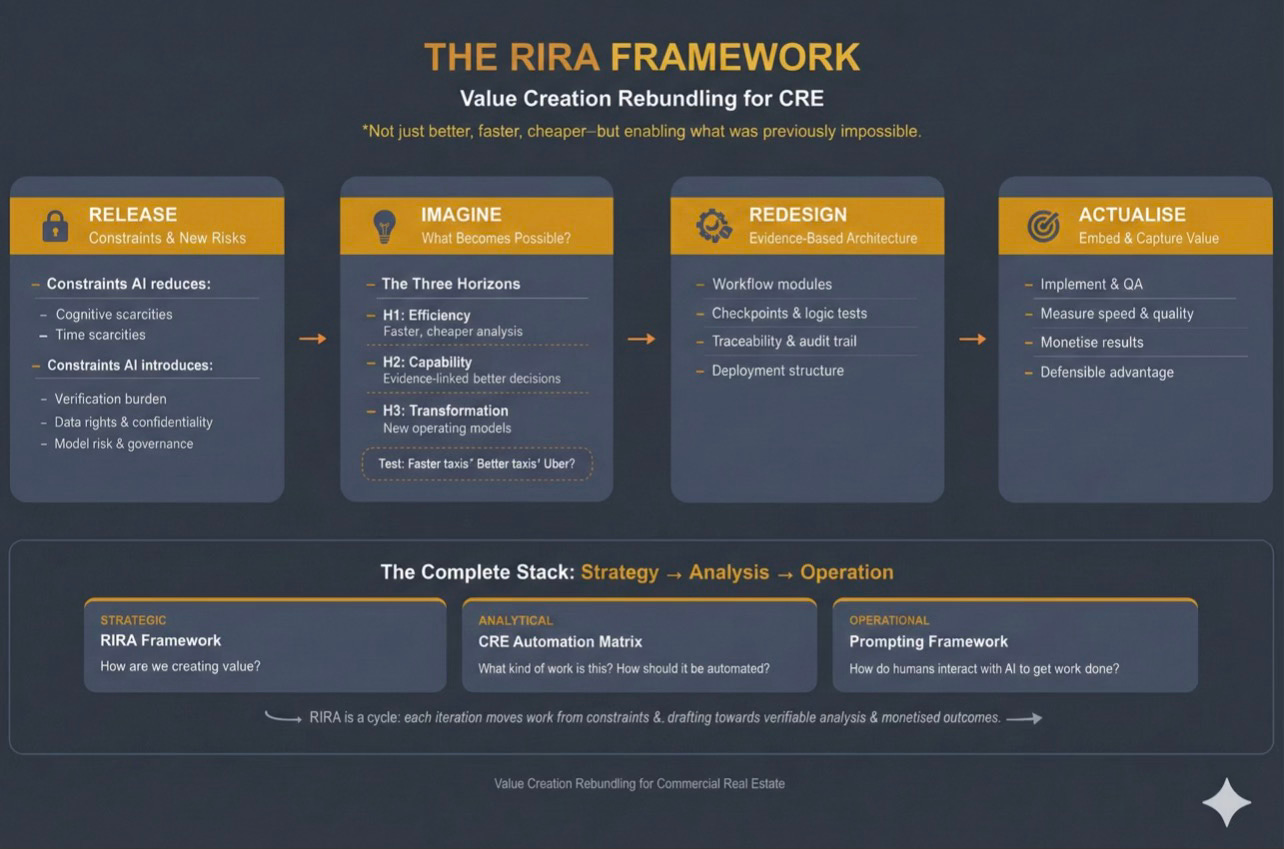
In late 2025 AI crossed a tipping point. What was, since the launch of ChatGPT in November 2022 an exciting, but somewhat maddening, new technology, morphed into being something much more robust. Yes, the ‘Jagged Edge’ of capabilities still exists, but an increasingly large number of business tasks and workflows are now firmly within AI’s purview. Put simply, we have reached the moment we need to take all of this seriously.
The Steam Engine Analogy
In the 1880s steam engines in factories started, slowly, to be replaced by new-fangled electric motors. And great productivity boosts were promised. But they never occurred. It turns out that replacing the power driving a central shaft with chains and pulleys made next to no difference to how well factory workers could actually work. It wasn’t until nearly four decades later, when factories themselves were redesigned, work disaggregated, and instead of one central power drive, a multitude of motors, serving a multitude of different processes, were introduced, that we see any meaningful productivity boost. And then it went ballistic - productivity soared and the roaring 20’s were underway.
Leveraging the new technology was impossible when bolted on to current workflows. Only when workflows were redesigned to specifically match the capabilities of the new technology did change occur. One needed to bake a new cake, not just put cream on top of the old one.
And now, history is repeating.
The ‘J’ Curve
Stanford Professor Eric Brynjolfsson has written about what he describes as the J-Curve. Where when new technologies are introduced, productivity actually declines for some time, before turning upwards dramatically. And this occurs because we have to invest in the intangible capital of new processes, organisational design, workforce training and complementary innovations, in advance of reaping any rewards. It is not until all of this melds into place, flywheels emerge, and benefits compound, that we stop being in the red.
And this is where we are now.
Changing Gears
The last two months of 2025 saw the release of ChatGPT 5.2, Gemini 3 and Claude Opus 4.5. Three enormously powerful frontier models. On top of which have emerged UX developments making interacting with the underlying power of these models increasingly easy. Google released Antigravity, OpenAI Codex 5.2, and Anthropic linked Claude Code with Opus 4.5. All of these are tools for developing ‘agentic’ systems (where multiple task-based ‘agents’ are strung together), primarily aimed at developers. What is emerging that is a step change is that these types of tools are being given interfaces that are, for the first time, accessible to non-coders. Most notably the new ‘chatbox’ version of Claude Code available via their desktop app.
We are very rapidly moving into the era of the ‘Business coder’. Where someone with no, or very limited coding skills, can summon up working software simply through natural language. The ability to explain one’s requirements clearly is now the defining skill. How well you understand ‘WHAT’ should be built, and how it should work, is the new superpower.
The barrier between thought and actualité is fading away.
We are all coders now.
I exaggerate to make the point, but give it another year and this absolutely will be reality.
But… how to know ‘WHAT’ to build?
Introducing The RIRA Framework
Let’s assume your ambitions stretch beyond having AI draft your emails, or summarise your documents. Let’s assume you’re ready to be serious.
Then you need to take The RIRA Framework (plus its two complements - the CRE Automation Matrix and the CRE Prompting Frameworks) seriously, because it is specifically designed for those thinking hard about how the real estate industry is set to change and how they, and their teams and companies, need to reposition themselves to maximise AI leverage.
What is it?
‘RIRA (Release–Imagine–Redesign–Actualise) is a strategy-to-execution framework for rebundling value creation in commercial real estate under conditions where AI materially changes the unit economics of analysis and content production.
It helps teams move beyond “using AI” towards engineering repeatable, evidence-based workflows that:
(i) explicitly surface what constraints are removed, and introduced, by AI
(ii) identify the new possibilities that become economically viable
(iii) redesign work into verifiable modules with controls
(iv) capture value through implementation, measurement, monetisation, and defensibility’
The critical terms are ‘constraints’ ‘new possibilities’ and ‘verifiable’.
AI both removes and introduces constraints: time and cognition are no longer scarce, but trust, confidentiality, and governance become critical.
AI enables us to be more efficient, or add new features, but far more importantly, it enables us to do things that were simply not possible before.
And AI makes whether something is verifiable or not, the cornerstone of how we design systems. You cannot, or at least should not, automate anything you cannot verify.
Why It Matters: The Strategic Problem
Al makes it cheap to generate outputs that look professional - memos, drafts, comps tables, market narratives, even pseudo-model commentary.
In CRE, where much value is mediated through decision confidence, risk allocation, and narrative control, this creates a structural trap:
The supply of plausible analysis rises sharply, but…
The supply of trustworthy analysis does not
RIRA is built to solve that mismatch: it forces a shift from “drafting at scale” to verifiable decision support, and from “internal efficiency” to capturable economic value.
What Goes Wrong Without It?
Without a RIRA-like discipline, organisations typically land in one of four bad equilibria:
- Productivity theatre: teams generate more documents faster, but decisions are no better; quality becomes subjective; risk quietly increases.
- Shadow Al: adoption happens informally; sensitive data leaks into tools; auditability is lost; governance reacts too late.
- Brittle automation: organisations automate workflows that should be redesigned, then get exception-handling chaos and reputational damage.
- Uncaptured value: real productivity gains occur, but are not measured, productised, or defended - so the benefit is competed away or simply absorbed as “busyness”
RIRA matters because it treats Al adoption as an operating model change with explicit trade-offs: you release constraints, but you also introduce new ones; you imagine new value, but you must redesign for evidence; you implement, but you must capture and defend value.
Before And After
Before AI, narrative drafting and expert packaging were scarce - and this scarcity was what commanded a premium.
But AI upends this: drafting and packaging becomes easy, a commodity. Everyone can do that.
What everyone cannot do, and probably won’t because it is hard and involves real effort and commitment, is:
Proving it’s right (evidence)
Ensuring it doesn’t break (controls)
Embedding it in real systems (integration)
Getting it to the right people (distribution)
Making stakeholders trust it (governance credibility)
This is what I mean by value creation rebundling: the components that once commanded a premium unbundle, commoditise, and the premium rebundles elsewhere.
Release, Imagine, Redesign, Actualise
The RIRA Framework is not meant as a sequential process. It’s an iterative loop. As you work your way through looking at constraints, and failure modes (which tell you how to verify or where to retain a human in the loop) you’ll develop a feel for how transformative you can be with any given workflow. Some will remain much as is, with maybe some efficiency tweaks. Some will lend themselves to being made more capable. Some though, you will discover, fit perfectly into that ‘value creation’ bullseye.
Within this iterative loop you will use the ‘CRE Automation Matrix’ Framework to understand exactly which tasks to automate, and where value lies, and this will be the subject of next week’s newsletter.
For now, the imperative to grasp is that AI has reached a threshold where dabbling is no longer enough. In CRE, as in all businesses, we have reached the point where considerable change is a certainty, and iterating on the past won’t suffice.
There’s a phrase that does the rounds - “AI won’t take your job, someone using AI will” - but it misses the deeper point.
As Sangeet Choudary put it recently: “New tech collapses old constraints. Once a constraint disappears, the logic of competitive advantage and business model design must be reimagined from first principles.”
In CRE, the constraints that defined value creation for decades - the scarcity of time, cognitive bandwidth, and expert packaging - are dissolving. What emerges in their place is a different scarcity: evidence, verification, integration, governance credibility. The premium rebundles around whoever solves for those.
Bolting AI onto existing workflows won’t get you there. Redesigning around the new constraint set will.
That’s what RIRA is for. Next week: the CRE Automation Matrix, which shows you exactly where to look.
Wow, the part about the Steam Engine Analogy and how electric motors only led to real productivity gains once factories were redesigned really stood out to me. That "bake a new cake" analogy is spot on for AI. Its exactly what we're seeing. Such a clear and insightful way to put it.
Hi im Siri.